Whether you are specifying a commercial balustrade, designing a residential staircase, or building a pool fence, choosing the right railing hardware is just as important as selecting the railing material itself. The components you select determine not only how the system looks, but also how well it performs under different environmental conditions.
Indoor and outdoor installations face very different challenges. Interior railings benefit from controlled temperatures and minimal moisture, while exterior systems must withstand rain, UV radiation, temperature fluctuations, airborne pollutants, and, in coastal areas, highly corrosive salt spray. Selecting the wrong hardware or stainless steel grade can result in premature corrosion, increased maintenance, and costly replacements.
This guide explains how to choose the right railing hardware for your next project, helping architects, engineers, contractors, distributors, and homeowners select the most suitable indoor railing hardware and outdoor railing hardware. By comparing stainless steel grades, surface finishes, installation methods, corrosion resistance, and commonly used components, you can ensure a code-compliant, durable, and visually flawless installation.
Why Environment Matters When Choosing Railing Hardware
The installation environment is the first factor that should influence hardware selection. Even premium-quality products can fail prematurely if the material is not suitable for the conditions in which it is installed.
Indoor Applications
Interior spaces benefit from controlled temperature and humidity levels. Because components are shielded from rain, salt, and industrial pollution, they experience lower exposure to corrosion. For interior staircases, shopping malls, office buildings, hotels, and residential homes, appearance often becomes as important as structural performance. Stainless steel handrail fittings with a satin finish are commonly selected because they provide a modern appearance while requiring minimal maintenance.
Outdoor Applications
Exterior hardware is in a constant battle with the elements. Rain and airborne moisture trigger oxidation, while intense UV exposure and temperature fluctuations cause materials to expand and contract. In coastal regions, corrosive salt air aggressively attacks metal surfaces. Furthermore, outdoor installations in public spaces often endure heavier use and higher physical impact, demanding elite structural integrity. For exterior installations, corrosion resistant railing hardware and structural longevity should always take priority over initial material cost.
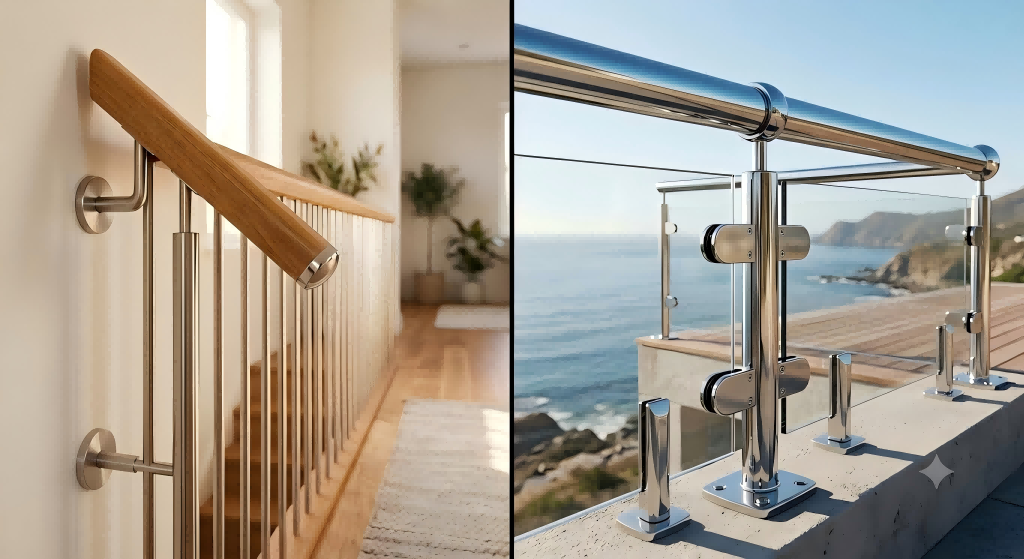
Indoor vs Outdoor Railing Hardware: Key Differences
Although many railing systems appear similar, their hardware requirements vary considerably depending on where they are installed.
| Feature | Indoor Railing Hardware | Outdoor Railing Hardware |
| Moisture Exposure |
Low |
High |
| UV Resistance |
Usually unnecessary |
Essential |
| Corrosion Resistance |
Moderate |
Very High |
| Recommended Material |
304 Stainless Steel |
316 or Duplex 2205 Stainless Steel |
| Maintenance Frequency |
Low |
Moderate |
| Typical Finish |
Satin or Brushed |
Mirror or Satin |
| Typical Applications |
Homes, Offices, Hotels |
Balconies, Decks, Pools, Coastal Buildings |
Outdoor hardware is generally manufactured using higher-grade stainless steel railing hardware designed to withstand long-term exposure to harsh environmental conditions.
Material Matters: Selecting the Right Stainless Steel Alloy
One of the most common specification mistakes is assuming that all stainless steel performs equally. In reality, stainless steel grades differ significantly in their resistance to corrosion. Visible rust staining, tea staining, or pitting is often caused by selecting the wrong material grade rather than poor manufacturing quality.
- AISI 304 (The Indoor Standard): Optimal for climate-controlled interiors, commercial office interiors, and residential indoor handrail systems away from high-humidity zones. This grade offers excellent structural strength and machining properties at a highly cost-effective price point, but it lacks the chemical resistance needed to withstand outdoor moisture and chlorides.
- AISI 316 (The Outdoor Workhorse): Recommended for standard outdoor configurations, high-traffic municipal walkways, and residential deck railing hardware. Formulated with 2% molybdenum, AISI 316 provides superior resistance to pitting and crevice corrosion caused by rain, humidity, and urban industrial pollution.
- Duplex SS 2205 (The Extreme/Marine Choice): Suitable for pool fence railing hardware, coastal boardwalks, marine docks, and highly corrosive industrial zones. It stands out with nearly double the mechanical yield strength of 316 and a chemical composition optimized to prevent stress corrosion cracking.
The Difference Between 304 and 316 Stainless Steel Railings
When comparing difference between 304 and 316 stainless steel railings, the core distinction lies in chemical composition. Grade 316 contains molybdenum, whereas Grade 304 does not. This single additive prevents outdoor atmospheric salts and moisture from initiating pitting, making 316 mandatory for most exterior environments.
Duplex 2205 vs 316 Stainless Steel for Marine Use
Many engineers ask whether duplex 2205 vs 316 stainless steel for marine use is the better choice for coastal projects.
|
Property |
316 Stainless Steel |
Duplex 2205 |
|
Corrosion Resistance |
Excellent |
Outstanding |
|
Strength |
High |
Approximately twice that of 316 |
|
Chloride Resistance |
Very Good |
Exceptional |
|
Marine Applications |
Recommended |
Ideal |
|
Cost |
Lower |
Higher |
For projects directly exposed to seawater or heavy salt spray, Duplex 2205 offers the highest level of protection and the longest service life.
Other Materials
- Aluminum: Lightweight and naturally corrosion-resistant, but lacks the high-impact resistance and structural weight capacity of stainless steel.
- Carbon Steel: Exceptionally strong and budget-friendly, but highly vulnerable to rust unless treated.
- Powder-Coated Steel: Offers a barrier layer against moisture, but if the coating chips, the underlying steel will rust rapidly under outdoor exposure.
Choosing the Right Surface Finish
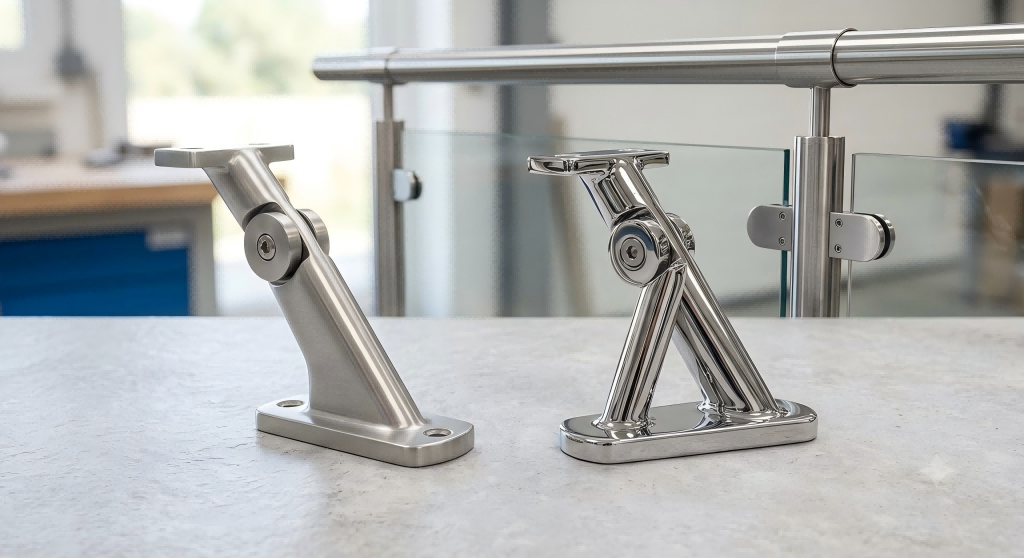
The surface finish of stainless steel railing hardware affects more than appearance; it also influences corrosion resistance, ease of maintenance, scratch visibility, and long-term performance.
Satin Finish
- Visual Profile: Matte, subtle brushed surface with fine parallel lines.
- Best for: High-traffic indoor environments and modern interior stair railing hardware.
- Pros: It effectively hides greasy fingerprints, smudges, and minor abrasions, keeping interior handrails looking clean with minimal maintenance.
Mirror Polish
- Visual Profile: Highly reflective, smooth, brilliant mirror-like gloss.
- Best for: Premium exterior applications, coastal frameworks, and demanding marine settings.
- Pros: The ultra-smooth buffing process eliminates the microscopic grooves found in satin finishes. Without these surface crevices, salt crystals, moisture, and industrial dust cannot cling to the metal, making mirror polish an outstanding choice for corrosion resistant railing hardware.
Installation Considerations: Weld vs. Weldless Mechanical Friction Fit
Installation methods significantly influence project cost, installation speed, and future maintenance. Today's architectural railing systems increasingly utilize weldless mechanical connections instead of traditional on-site welding.
Traditional Welding
Welding provides a continuous, high-strength structural bond but carries steep hidden costs. It requires certified on-site labor, grinding machinery, post-weld chemical passivation, and extensive finishing time. For outdoor systems, welded joints are highly susceptible to localized rust if the heat-tint zone is not properly passivated. Traditional welding remains appropriate for heavy structural steel fabrication but is becoming less common in modular stainless steel railing systems.
Weldless Mechanical Fittings
Modern architectural handrail systems rely heavily on weldless mechanical friction-fit configurations. These components feature internal insertion sleeves engineered with knurled or ribbed textures. This design establishes a permanent, rock-solid mechanical grip when driven into a clean, deburred tube end with a soft-faced mallet. Omitting hot work on-site accelerates installation times, slashes labor costs, and maintains the pristine finish of the factory hardware. These systems are especially popular in commercial buildings, hotels, residential developments, and prefabricated railing installations.
Selecting the Right Railing Hardware Components
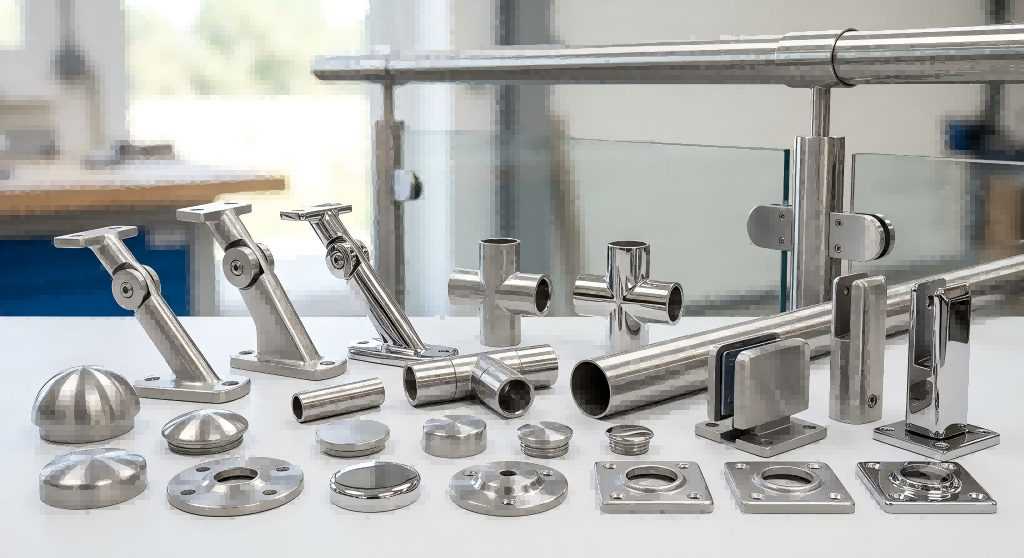
A complete, high-performance railing layout relies on a specialized ecosystem of interconnected components. Instead of choosing fittings individually, consider the railing system as a complete assembly tailored to the application:
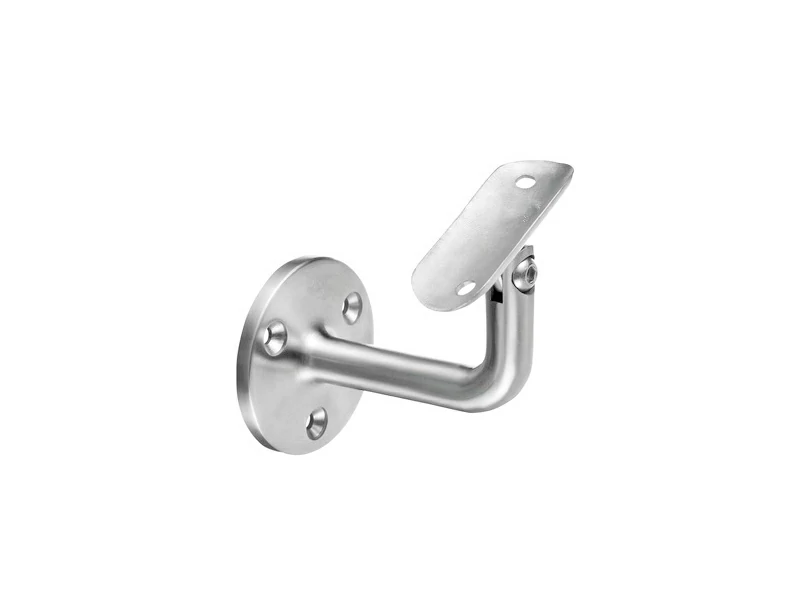
- Handrail Brackets & Handrail Supports: Essential for anchoring handrail runs to walls or vertical posts. Interior setups utilize decorative or pivoting handrail brackets for design flexibility, while exterior runs benefit from heavy-duty fixed handrail supports cast from AISI 316.
- Glass Clamps & Glass Spigots: Used to anchor structural glass infill panels. Choose heavy-duty glass clamps with weather-resistant rubber gaskets to secure panels against outdoor wind loads, or robust glass spigots for core-drilled pool barriers.
- Tube Joiners, Connectors, & Handrail Connectors: Internal tube connectors, handrail connectors, and mechanical tube joiners extend or redirect pipe configurations smoothly.
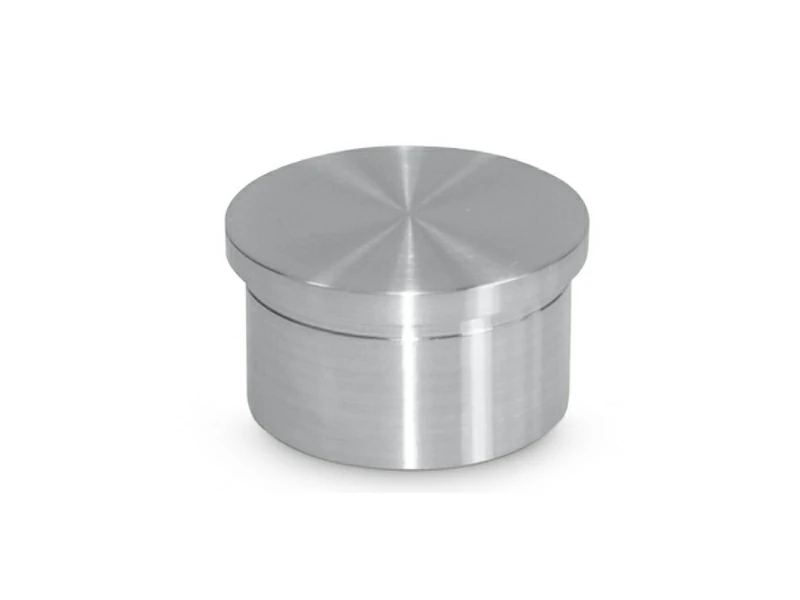
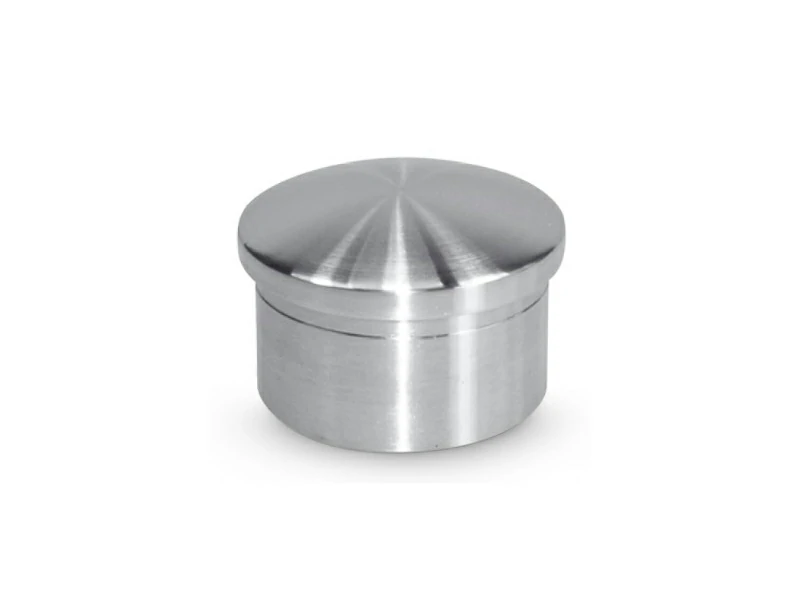
- Handrail End Caps: Installed to seal off open pipe ends, preventing moisture from pooling inside the tube. Options range from minimalist flat profiles to rounded domes.
- Base Plates & Wall Flanges: Heavy structural mounts that secure vertical baluster posts to floors or walls. Ensure base plates and wall flanges feature integrated dress covers to protect structural anchors from standing rain and debris.
Application-Based Selection Guide
Choosing the right railing hardware becomes much easier when you start with the project's specific application.
|
Application |
Recommended Material |
Recommended Hardware |
|
Residential Staircase |
304 Stainless Steel |
Handrail Brackets, Tube Joiners, Handrail End Caps, Wall Flanges |
|
Commercial Staircase |
304 or 316 Stainless Steel |
Heavy-Duty Handrail Supports, Base Plates, Tube Connectors |
|
Balcony Railing |
316 Stainless Steel |
Glass Spigots, Glass Clamps, Handrail Supports, Base Plates |
|
Deck Railing |
316 Stainless Steel |
Tube Joiners, Base Plates, Wall Flanges, End Caps |
|
Pool Fence |
316 SS or Duplex 2205 |
Glass Spigots, Glass Clamps, Handrail Fittings |
|
Coastal Property |
Duplex 2205 |
Marine-Grade Glass Spigots, Tube Connectors, Base Plates |
|
Shopping Mall |
304 Stainless Steel |
Handrail Brackets, Glass Clamps, Tube Joiners |
|
Hotel & Resort |
316 Stainless Steel |
Stainless Steel Handrail Fittings, Glass Spigots, Decorative End Caps |
|
Public Infrastructure |
316 Stainless Steel |
Heavy-Duty Handrail Supports, Base Plates, Wall Flanges |
Common Mistakes to Avoid
- Using 304 Stainless Steel in Coastal Areas: Installing 304 stainless steel near the ocean leads to rapid tea staining and pitting corrosion due to prolonged salt spray exposure. Grade 316 or Duplex 2205 should always be used instead.
- Using Satin Finishes in Coastal Areas: Specifying a brushed satin finish right next to salt spray allows salt crystals to settle in the micro-grooves, leading to surface tea-staining within months.
- Selecting Decorative Hardware for Structural Applications: Some fittings are designed primarily for aesthetic purposes. Always verify load capacity, engineering specifications, and compliance with local building codes.
- Mixing Different Metals: Combining stainless steel with incompatible metals creates galvanic corrosion. Use stainless steel fasteners with stainless steel fittings, avoid direct contact with untreated carbon steel, and utilize isolation washers where dissimilar metals cannot be avoided.
- Choosing Appearance Over Performance: A beautiful finish is important, but material selection should always prioritize long-term durability. Mirror-polished 316 stainless steel performs better outdoors than satin-finished 304, and Duplex 2205 offers the highest protection in marine environments.
Maintenance Tips for Indoor and Outdoor Hardware
- Indoor Care: Wipe components down periodically with a microfiber cloth and a mild soap solution to clear skin oils, fingerprints, and dust accumulation. Avoid abrasive cleaners that can scratch the finish.
- Outdoor Care: Flush exterior railings with clean water periodically to rinse away accumulated salt crystals, dirt, and atmospheric soot. For marine or industrial environments, apply a specialized stainless steel passivating cleaner twice a year to restore the protective chromium oxide layer.
Conclusion
Selecting the right railing hardware is about much more than appearance. Environmental exposure, stainless steel grade, surface finish, installation method, and hardware configuration all play critical roles in determining the safety, durability, and lifespan of a railing system. By carefully matching materials and components to the installation environment, architects, engineers, contractors, distributors, and homeowners can build railing systems that deliver lasting safety, low maintenance, and a professional architectural appearance.uplex 2205 offers the highest protection in marine environments.